Showing posts with label revision; writing process. Show all posts

3.06.2014

Why Playing It Safe May Be the Most Dangerous Game of All

I read some exchanges recently between picture book authors in which one posed the question (and I’m paraphrasing here) as to whether she could do whatever she wanted with her main character in her manuscript, or whether it was better to perhaps “play it safe.” 
A few authors responded right away that it’s important to “play it safe” and they meant that it’s probably best to stay in familiar territory for picture book age readers who are too young to understand the dangers of certain activities, or too young to understand the difference between reality and fantasy.  I hastened to add my voice to the comments with a quick 
DON’T PLAY IT SAFE! message and this got me to thinking, if any authors are out there assuming they have to play it safe for picture book age readers, my position on how detrimental that way of thinking is deserves a bit more space than a Facebook comment box allows. 


As someone who’s edited and published hundreds of picture books, my position has never flagged on one particular point about what makes a great picture book:  whether your characters are human, animal, or otherwise; whether your story is realistic or fantasy; whether your story is contemporary or historical; whether your approach is serious or funny; whether your story is practical or completely off the wall…anything goes as long as a very young child will be able to relate to your main character’s emotions, perspectives, and world view.  

A story can open with our main character in a kitchen with mom and dad and dog all safely and soundly situated—to many readers, that’s familiar, but to other readers such a scene will be a fantasy and not familiar at all—not by a long shot. A story can open with our main character caped and masked and flying through the trees—to many readers, that will be familiar because it’s exactly how they think of themselves all the time, but to other readers it will be a brand new idea, maybe a little scary, but maybe a little fantastic, too.  As long as the trajectory of the picture book story taps into the emotions and feelings a very young child will find familiar, that’s as familiar and “safe” as a picture book needs to be. As long as the emotional needs, interests, and resolutions of the main character in a picture book resonate with the very young reader’s emotional knowledge and capacity, that’s as familiar and “safe” as a picture book needs to be. As long as that’s solid, the trappings and settings and structuring of the picture book can be whatever your imagination can conjure—and here’s the very place where I see most new picture book authors not pushing themselves enough. 

Authors need to allow their imaginations to take them all over the place, particularly out of safety zones—if authors play it too safe, we end up doing a disservice to ourselves and a disservice to our young readers. Where but in stories can we allow our youngest readers to not play it safe, to try new things, to explore, to roam, to make mistakes and make amends, to reach higher, deeper, and further than we ever thought possible? And where but in stories can we allow ourselves the very same?  And if we don't do all this in stories for children, I shudder at the cost that will take on our collective imaginations and creativity.

We wrap our children too tightly in bubble wrap sometimes—and sometimes, indeed, it’s completely necessary, but not in stories. Stories are where we must let our children play and dream and imagine roles and lives for
themselves that they’ve never thought about before; that’s how stories help children explore their sense of empathy, sharpen their resolve, enrich their dreams, and expand their imaginations. There’s no harm in that at all as long as the stories we provide as the vehicle for this ride carry within them the emotional core young children will be able to understand as their own.

If we push ourselves out of the familiar to ask "what if?" and to find the magic in the world, think how much more interested our children will be in doing the same. The safest route is rarely the most scenic. So feel free to explore creatively and imaginatively in your stories so children can explore the world in the same way. And if you find yourself spinning your wheels in a safety zone, go listen to young children telling each other stories and have them tell stories to you. I promise, the emotions will be familiar, but the stories will be out of this world--and that's a trip well worth taking.


(c) emma d dryden, drydenbks LLC


10.24.2013

Falling In Lust With Our First Draft (Or, What Not To Do On A First Date)

Some time ago I posted about Revision [read post here]. Since that time, I’ve had the privilege to speak with dozens of authors about the revision process, revision techniques, and more. As recently as this past weekend, I spoke at a workshop about Robust Revision – and all this talk about revision has gotten me thinking about first drafts.  And this has gotten me thinking about first dates…but I’m getting ahead of myself.
Writing is a process of discovery and we don’t always produce our best writing when we first get started on a book.  The first draft is the time to shout “Yes! Yes!” to our ideas and write HOT—write with passion, write with abandon, let it all bubble out there onto the page, don’t play it safe in any way. Then comes a cooling off period…the time when we must step away from the writing and the work for a little while. And then, when it comes time to revise, we will be able to write with a cooler head. Revision is the chance to look critically at what we’ve written to see: if it’s really worth saying; if it says what we meant to say; if a reader will understand what we’re saying; and if a reader will feel want we want them to feel. But before that we need to write HOT.
The hottest moments of our work is the getting it all down in a messy, sprawling first draft. The passion. The “Yes! Yes!” The hot mess. Whether a planner or a panster, however writers get that first draft down is fine. It takes a lot of courage to get something down on paper at all, and what I hope authors will embrace is the notion of writing without revision in first drafts—writing with abandon! There will be plenty of time later for the inner editor to get to work, for the critical eye to start seeing all the faults, for the lights to go on, for the rearranging and reorganizing, for the make-up and polishing.
That time of great intensity and heat is a precious time for an author and their work—and really the only time in the writing process where we can feel free to do whatever we want to do. So do it! Don’t stop. Don’t edit. Don’t think too much. Just go for it.
OK, so we’re in the heat of passion with our first draft—it’s a lustful, expressive, passionate tangle between a writer and the work.  “Yes! Yes!”  But…
…as most teenagers will tell you, the very worst thing that can happen in a heated make-out session on a first date is when someone whispers, “I think I’m in love with you.”
Whoa…say, what?
And that heat index suddenly goes down…
                                                  down…
                                                  down…
       
Come on, admit it. I’m right, right?

In the context of writing first drafts, I am a huge proponent of being as insatiably lustful as possible—with words, with ideas, with characters, with scenes, with situations, with drama, with dialogue, with settings, with STORY.  And I caution all writers to approach the writing of first drafts in lust, not in love.  And here’s why: Falling in love too soon with what we've written will absolutely prevent us from being critical and willing to change it.

If we fall in love too soon with what we’ve written, we will be far too hesitant to change it even if we know it’s not that great. But staying in lust with a first draft? That’s more like being on a hot first date with our writing—and that way we can stay open to finding out more about what we’re writing, seeing if we’re really compatible. And we won’t feel guilty for playing the field and chasing other ideas to determine if a new and better story idea comes along, so we can dump the old one without a second thought.

With a first draft, we need to be as ruthlessly lustful as we want—because it will all be over soon enough! And then the necessary period of cooling off can begin. (Because, face it, so much literary lusting can be exhausting and we need to rest and clear our heads.)  And the process of revision can commence. And that’s when the falling in love happens.

(c) emma d dryden, drydenbks LLC

5.29.2013

Playing Make-Believe: World-Building and World-Crafting


Writers are atlas makers
Do you remember playing make-believe when you were little? Playing with your friends, or with dolls or stuffed animals, and creating elaborate and often complex scenarios, relationships, situations, and rules within a make-believe world filled with magic, or monsters, or heroes, or explorers, or princesses, or anything else we could conjure up from our imaginations?


When we’re children make-believe is a way for us to be safe while experimenting with the world, testing boundaries, trying on new personas, pretending to be older, pretending to be adults, letting our imaginations take us as far away from ourselves as we can go, into new worlds and new landscapes. And then, just as Mickey returns from the Night Kitchen in time for breakfast, we can come home again, back into ourselves and into our real worlds, richer for the world of make-believe we know we can explore again whenever we want.


As we grow up, many of us outgrow make-believe. But there are some people who don’t outgrow make-believe at all, and they became…fiction writers! I loved make-believe when I was growing up, and I have no doubt that speaks in some part to how I became a children’s book editor. And one of the most fantastic parts of make-believe for me was the world–the multiple worlds, in fact–I could create in my imagination. Worlds in which I could set all the rules, worlds in which feared creatures became friends, worlds in which puppy-love crushes were manifested, worlds in which disabilities were assets, worlds in which I could be anyone and anything I wanted. So what better way to stay close to the land of make-believe than journeying into worlds created by storytellers?


Whether fantasy or realism, crafting the worlds of our stories is really akin to setting up the worlds we created as children playing make-believe, only this time we’re responsible for creating worlds rich enough, believable enough, and inviting enough for readers to join us, to journey with us, to stay there with us.


World-building is an exciting and often complicated part of writing a great book, made more complex when you recognize that the world of a story must exist on two levels–the actual world in which a main character lives and the internal world in which a main character lives–the emotional and psychological world.

Writers are atlas makers, crafting the maps their characters will need to explore and find their way through literal and figurative landscapes. And the more clearly marked and detailed and interesting these maps are, the more excited and curious readers will be to find their way through these landscapes, too.


 (c) emma d dryden, drydenbks LLC

This post first appeared on May 7, 2013, as a guest post for Ventana Sierra Workshops (www.ventanasierraworkshops.com) in advance of a June 14-16, 2013, workshop in which Emma Dryden conducts a session entitled, "Constructing the World: Internal & External World Building"

3.29.2013

Hearing and Tasting Our Work


"I always find if you read fiction out loud you know what you have to change by what you stumble over." - Alice Hoffman.


As anyone who has worked with me knows, I'm a huge proponent of reading our manuscripts aloud.  It's critical to do this when your work is a picture book--we can all agree that the most successful picture books are not only those that can be read aloud over and over again, but those that we want to read aloud over and over again. So the very best way to write a picture book is to read it aloud as you go along. It's equally critical, though, to read your fiction and non-fiction aloud. Yes, it will take a lot of time, but this must be part of the writing process because the reading process is itself a multi-layered sensory experience. We don't read only with our eyes--as we read, we feel a story; as we read, we sense a story; and as we read, we hear a story.  And so, the very best way to write a novel or non-fiction that will appeal to readers is to read it aloud as you go along. 

Saying something aloud makes it more real for us. We can think something, we can feel something, we can wonder about something, we can even write something down. But I've often found it to be true that when we say what we're thinking or feeling, when we give a voice to it, that's usually when it becomes most real, whether we like it or not. We can't take it back. It's out there.  It's been witnessed. So too, our manuscripts. We must witness our own stories, we must witness our own writing--and by doing so, we will experience our stories and our writing in new ways, in ways that will reveal flaws, in ways that will reveal poetry, in ways that will reveal what we need to adjust, revise, omit, add.  

As we read aloud, we feel our words on our tongues--we taste our words, we taste our stories--and just as there are certain textures and flavors of foods we find delicious or distasteful, so will we begin to recognize what textures and flavors of our writing we find delicious or distasteful. And in so doing, we will be refining our work in ways that will engage the deeper senses of our readers.

We must hear our words. Taste our words. See our words. Feel our words. As we do, our senses will become more acute and we will experience our stories and ourselves more fully, we will share our stories and ourselves more fully.


(c) emma d dryden, drydenbks LLC
3.18.2013

Are You Being Served? A Recipe for a Great Critique Group


 Ingredients
- 2-12 dedicated authors (can be of different genres & formats; can be of same genre & format)
- heaping doses of imagination
- heaping doses of respect
- heaping doses of sensitivity
- liberal doses of gentle honesty (if you opt for brutal, critique group will become too tough and hard to swallow)
open-mindedness and creative flexibility
- willingness to ask questions and listen to answers
- generous sprinkles of laughter (can use hysteria and guffaws if desired)
timer (enables fair attention paid to each author)
- cough drops & water (enables requisite read-alouds)
bathroom & stretch breaks
delicious food
comfortable setting (a cozy setting is even better, if you can find it)
wine or spirits (for after critiques are completed! Some may find wine or spirits appropriate during, but proceed with caution)
optional: friendly dog and/or cat; fireplace; views (ocean, woodland, mountains, etc.); anything else to enhance experience

_______________

Directions:
Gather ingredients together on a regular basis. Stir with professionalism, exuberance, imagination, and inspiration. Surprises may result. Quiet moments of reflection may be required. Questions can be asked for which there may be no immediate or clear answers. That's ok. Allow for staying open to possibilities; critique groups vary based upon the ratio and balance of ingredients.  

Caution: If each author doesn’t feel heard and respected, the ratio of ingredients has gone awry and you will most assuredly want to double-check your recipe.

Note: Every once in a while, it's a good idea to add a one-time ingredient to this recipe, such as a professional editor or published author who will provide a new voice and perspective to the discussion – this can best be achieved over a weekend. For a sample taste of this sort of enhanced group experience, go to this post from the Route 19 Writers blog. 

This recipe serves many, including a richer society of writers and readers.


  (c) emma d dryden, drydenbks LLC

12.13.2010

Alignment

As artists we seek to create our own sense of the chaos. Through our storytelling, poetry, painting, composing, sculpting, designing, we wrangle and wrestle with a swirl of ideas and emotions that seem at once as heavy as lead and as elusive as air. We all of us seek to create our own sense of the chaos that is composed of family, relationships, career, health—and with each decision we make, we strive to bring that which we don’t know and that of which we’re not sure into focus, into perspective, into alignment.

Alignment. The lining up, the adjusting, the balancing of things. The relationship of things. In art and in life, we can but hope to be blessed from time to time with the sort of balance that makes us feel whole, enriched, an integral part of something wondrous—and through such alignment, through a realization of the power and validity of interconnectedness, we can create our greatest artwork, we can become our greatest selves.

As an editor, one of my most important roles is to help a writer or illustrator identify, examine, and fix that part of their work which might be at all unstable and out of alignment, for leaving such an instability in the construction most certainly risks the integrity and security of the whole. A remarkable result of such a process is always the excited (and, indeed, sometimes daunting) realization that everything is interconnected. The focused strengthening of one character or one scene necessarily strengthens the whole.

The past few months I’ve been contending with an internal alignment not just of ideas, emotions, and decisions, but a literal alignment of the vertebrae in my spine. Understanding and respecting the notion that our spines are sturdy columns that protect some of the most delicate elements in our bodies and are cores as essential to our bodies as trunks are to trees, it’s no wonder and no mistake that for our bodies to be fully whole and healthy, it’s necessary that our vertebrae align. And if they don’t—if just one vertebra slips out of place—the consequences can be anything from a nuisance to painful to life-threatening. Since having a remarkably successful lower back fusion to stabilize and strengthen my back last month, we’ve discovered a disc in my neck that is highly unstable, badly out of alignment, causing considerable pain and, most importantly, impinging on the spinal cord and threatening my health. The instability is not the result of the lower back surgery, as it’s clear this disc has been compromised over the course of time; it’s the revelation of the condition that is the result of the lower back surgery. The revelation of an organic, essential interconnectedness that’s critical to the health of the whole. I am lucky to be in a position to address this situation quickly and will do so tomorrow as I undergo surgery once more. What feels most amazing to me, though, is the revelation I had last night—that it seems the journey I had to go through for my lower back was all meant as a means to expose this even greater and urgent condition in my neck, one that was on track to manifest itself at some time in the future, assuredly with far more severe consequences.

I believe the stars align. I believe the clouds do part to reveal secrets when the time is right. I believe chaos can be brought into focus. And by such alignment, we are able to soar to greater heights when we fly and find the solid ground we need to feel rooted. Alignment of the pieces to reinforce the whole. I believe this within the stories we have to tell, with the decisions we have to make in our lives, and within our own bodies, as long as we’re paying attention.

                                                                                           (c) emma d dryden, drydenbks llc

12.05.2010

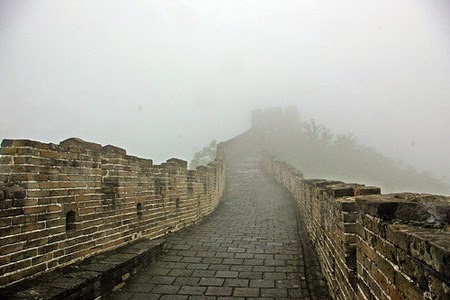
The Great Wall

A few years ago, my partner and I were lucky enough to be able to take an incredible month-long trip to China. It took about six months of planning and preparation and before that, it had taken several years of “what if”ing to set it all in motion. We wanted to see the Yangtze River before it was entirely dammed. We wanted to see the Potala Palace and Tibet before it’s completely overrun with Chinese. We wanted to ride camels along what had been part of the Silk Road route. And we wanted to walk along the Great Wall. It was, in the truest sense of the phrase, a trip of a lifetime because we were able to do all the things we’d wanted to do and more. We experienced sights and sounds and emotions and awe – things so many people don’t have a chance to ever experience. 

One of the multitude of mysterious and marvelous impressions from that trip has stayed with me in a way that nothing else has—and it’s the powerful reminder that the journey is as important as the destination. Indeed, that the journey is sometimes even more important than the destination. It was cloudy and overcast when we reached the Great Wall. As we climbed higher and farther along the wall into the mountains, we found ourselves walking in the clouds themselves, unable to really see much beyond the grey-green rolling hills just surrounding the wall itself. At first, we were terribly disappointed, raging at the sky and wishing for the sun to break through so we could see the vistas and the land beyond. And as we raged, we started to fairly race to the next tower on the wall, to see if, just maybe, we’d get a better view. And it was then that I stopped us. Just stopped us so we could listen and look around and realize the magnificence of what we were actually doing, of where we were actually walking and standing, of the history, of the moment. We stopped in order to take mental and physical note of the journey itself. It seemed critical then to put aside the “when will we get there” in order to celebrate the “here we are.” And in doing so, we could rejoice in all that had transpired to bring us to that remarkable and special place—to capture the power of all that we’d done and all that the universe had allowed over many years to bring us to where we were right then. No less. No more. And just perfect.

So, we didn’t see the expansive views of mountains and unending wall we thought we’d see; that particular gift, for whatever reason, remained hidden. But the gifts we were given were, I think, far greater in depth and beauty – the gift of the knowledge that we had achieved something magnificent without even recognizing it; the gift of the knowledge that in experiencing exactly what we experienced, our lives were forever changed; the gift of being able to stop and know the now; and the gift of the next “what if” – what if we are able to come back to this place someday and on that day the sun might be shining?

And so it is with our lives and our storytelling. And so it can be with our health and our relationships. Sometimes it’s overwhelmingly vital for our souls and our selves to pay attention to the journey, to appreciate the efforts and the achievements, to allow the clouds to hide secrets not yet meant to be revealed. It seems to me if we’re too intent on only reaching our destination we lose a sense of magic and mystery. For it is by knowing where we are on our journey and letting ourselves be at ease with the unexpected that we will make our way to brilliant and rich destinations –and not necessarily the ones to which we thought we were always headed. How exciting it is to just think...what's beyond the great wall?

(c) emma d dryden, drydenbks llc

10.14.2010

Getting Another Opinion

Having been a children’s book editor for over twenty-five years, one of the things I’ve said most often to authors is that the business of evaluating a book (indeed, art of any kind) is highly subjective, there are going to be many varying opinions of their work and so it makes sense that they would submit their work to several different places—or to have critique sessions with several different editors or agents—in order to gain the best possible feedback for their work. I warn them that for as many different editors and agents who see their work, an artist will be obtaining as many different points of view and interpretations of their work and, indeed, some of the interpretations and ideas about their work will be diametrically opposed. The feedback, when taken all together, might at first seem overwhelming, confusing, and unclear—with so many different opinions about how best to revise or recraft a project, it can often feel as though everyone’s opinion, no matter how reputable and professional, is canceling out everyone else’s opinion, thereby leaving the author without any clear direction or decision.
     Though it may not always seem so at first, this business of submitting work for critique and evaluation is a crucial and ultimately enlightening process for an artist. What starts to happen through this process is that the author will ultimately find that one person’s interpretation and suggestion resonates with them on a level far deeper than reason. One person’s grasp of and response to an author’s work will seem right to the author. The suggestions offered will make a kind of sense that’s hard to quantify, but that will make the author feel the person is really getting their work and understanding what it is they’re trying to say. That the person is really getting them. And so it will be those suggestions and ideas that the author will feel excited to think about, the revision process will become much clearer, and the author will feel confident their work is going to get stronger.
     About a month ago, I decided it was high time to see an orthopedic surgeon to determine what was causing my lower back pain. X-rays. MRI. The surgeon I saw—who performed an excellent surgery on my lower back in the past—brought his knowledge of my medical history, his remarkable surgical prowess, and an impeccable pedigree to bear on his assessment and he prescribed a very serious surgery that would render me pain free. I trusted his evaluation (after all, he knew my back intimately!), I was excited that I could undergo a process that would ease my pain, and I signed up. It felt extreme, but I didn’t think I had much of a choice. And, besides, he’s the pro, right? He would know. And then, through the urging of several friends, I decided to go for a second opinion. Honestly, I fully expected the second surgeon to look at everything and completely agree with the first doctor’s prescription and I’d be good to go.
     I was wrong.
     Bringing remarkable surgical prowess and an impeccable pedigree to his assessment, the second doctor’s opinion was pretty much diametrically opposed to the first, and a non-surgical course of action was prescribed. I became excited that I could undergo a process that would ease my pain without having to undergo such a serious surgery after all and I decided to think twice about having the surgery. But…something about what the doctor was suggesting didn’t put me wholly at ease. That, combined with the fact that if I was going to have surgery, I needed to have it this month (due to a whole host of insurance issues as well as upcoming business commitments), I was uneasy about having to decide between two such extreme positions. And so I went for a third opinion. I fully expected the third surgeon to look at everything and completely agree with either the first doctor’s prescription or the second doctor’s prescription.
     I was wrong.
     Bringing remarkable surgical prowess and an impeccable pedigree to his assessment, the third doctor offered an entirely new option to me—a surgery that’s a good deal less severe than the one first prescribed and that seems necessary because of some compression on nerves which would probably not be eased by a non-surgical course of treatment. We talked about my weight, we talked about my neurological health, we talked about my age and what my spine was already doing to try to heal and strengthen itself in light of what the X-rays and MRI were showing. And I knew. This was the doctor. This was the course of treatment. Though he didn’t know me and my medical history and though he was prescribing surgery (all surgery, no matter how minor, is a serious step to take), the way in which he came to his conclusions and the suggestions he was making made sense to me. His course of action feels right. And so, I will be following his course of treatment and feel confident that I’m in the right state of mind and body to come through it stronger, healthier, and wholly prepared to get back to my life.
     Here’s the thing, though, that woke me up at 4:30 this morning and prompted this post. I could not have made a decision as to how best to proceed without having heard and considered several opinions. The fact that the opinions were so varied is extraordinary to me and for a short while, it rendered me a complete wreck. Who’s right? What do I do? I’ve learned through this process, though, that in order to reach that place in which I am most emotionally and psychologically comfortable to be willing to undergo a course of treatment that will make me feel better, I needed to have myself examined and interpreted by more than one person. I needed to get feedback, and then more feedback, and then more again, until something I heard resonated with me on a level far deeper than reason. Until something I heard felt right to me and gave me the tools, both emotional and tangible, to proceed. I am going to be undergoing a physical revision in about a week and I feel great about the course on which this revision is going to take me because I have found someone to help me get there who gave me a critique and is offering solutions that I feel will make me stronger.

(c) emma d dryden, drydenbks LLC