Showing posts with label self-expression. Show all posts

6.02.2017

Adjusting

Well, we've made our BIG move from New York City to Hope Street in Bristol, Rhode Island, and I've been learning what it takes to adjust.

The dictionary defines "adjustment" as "the small alterations or movements made to achieve a desired fit, appearance, or result." In this new apartment, new town, new state I find myself in a process of figuring out what my desired fit, appearance, or result are. It's been neither terribly easy or terribly hard--it's been a process, though, to which I've had to stay alert and open. Every day I need to remind myself that adjustment is a process that I can control. Whatever fit I want, I can adjust myself to get there. 

For writers and artists, isn't the process of revision the very same thing? The figuring out of what alterations and movements need to be made to achieve a desired fit, appearance, or result. Revision can be tricky, messy, confusing, even scary--and it can be exhilarating and revealing. So too when we are forced to adjust to a new situation in which we find ourselves within our lives or our art. 

Taking a larger view, this is definitely a period of upheaval and change throughout our society--requiring constant adjustment to try to make sense of things that I feel are senseless. Sometime, adjustment doesn't achieve a desired fit, but we do the best we can. As I take this journey, I embrace what sailors know instinctively--you can't direct the wind, but you can adjust the sails, and keep beating towards your destination.

6.08.2015

Lunacy


   Lunacy: Mid 16th Cent. Originally referring to intermittent insanity believed to be caused by 
changes of the moon. From lunatic + -acy
  Lunatic: Middle English; from Old French lunatique; from Latin luna (moon)
__________


Confession: The other night a writer friend and I mistook the rising moon for the setting sun.

"How," you might ask, "is such a thing possible?" We were driving in a caravan with several other people on darkened roads en route to see the star-filled sky. We arrived at the appointed spot and jumped out of the car, eager to watch the remains of the huge yellowy-orange sun set in the vast purple-black sky starting to fill with constellations. We watched, enraptured, and then my friend and I looked at one another and said, "Wait. Did you see that? Is the sun higher in the sky now? Wasn't it lower a second ago? What's going on?"

No one else seemed to be alarmed by the apparently rising sun at 9:30 at night. We kept watching. We heard someone say "moon." And then we knew. We were watching the rising of the full moon! An enormous yellowy-orange full moon. And we started to laugh. Laughter that doubled us over. Laughter that infected several of the people around us who didn't know what was so funny, but who were happy to laugh along with us. Laughter that made our stomachs hurt. Laughter that didn't stop. The laughter of lunacy.

Earlier that morning this same writer friend and I had been in a situation where someone reminded us to expect emotions to run high and to expect the unexpected because of the full moon. (It fact it seems this particular full moon was such it generated this article: http://www.feelguide.com/2015/06/02/this-week-full-sagittarius-moon-in-mercury-retrograde-is-wreaking-havoc-on-nearly-everyone/) And earlier that evening this same friend and I had been at dinner with a writer talking about the wonderful subtleties and lessons of the movie "Moonstruck". We should have known. 

"Those people who recognize that the imagination is realitys master 
we call sages, and those who act upon it we call artists or lunatics."  - Tom Robbins
In the spirit of imagination being reality's master, we've decided not only did the full moon indeed cause our momentary disorientation, but we've also decided it makes perfect artistic sense for creative people like us to turn the rising moon into the setting sun. Why not? More people should try it. And if a flexing of the imagination is accompanied by the uncontrollable laughter of lunacy, even better. Better for our stories and better for ourselves.


I wonder what my imagination will generate during the next full moon. 

And what will your imagination create? 

Join me in the lunacy!


(c) drydenbks LLC 2015


3.06.2014

Why Playing It Safe May Be the Most Dangerous Game of All

I read some exchanges recently between picture book authors in which one posed the question (and I’m paraphrasing here) as to whether she could do whatever she wanted with her main character in her manuscript, or whether it was better to perhaps “play it safe.” 
A few authors responded right away that it’s important to “play it safe” and they meant that it’s probably best to stay in familiar territory for picture book age readers who are too young to understand the dangers of certain activities, or too young to understand the difference between reality and fantasy.  I hastened to add my voice to the comments with a quick 
DON’T PLAY IT SAFE! message and this got me to thinking, if any authors are out there assuming they have to play it safe for picture book age readers, my position on how detrimental that way of thinking is deserves a bit more space than a Facebook comment box allows. 


As someone who’s edited and published hundreds of picture books, my position has never flagged on one particular point about what makes a great picture book:  whether your characters are human, animal, or otherwise; whether your story is realistic or fantasy; whether your story is contemporary or historical; whether your approach is serious or funny; whether your story is practical or completely off the wall…anything goes as long as a very young child will be able to relate to your main character’s emotions, perspectives, and world view.  

A story can open with our main character in a kitchen with mom and dad and dog all safely and soundly situated—to many readers, that’s familiar, but to other readers such a scene will be a fantasy and not familiar at all—not by a long shot. A story can open with our main character caped and masked and flying through the trees—to many readers, that will be familiar because it’s exactly how they think of themselves all the time, but to other readers it will be a brand new idea, maybe a little scary, but maybe a little fantastic, too.  As long as the trajectory of the picture book story taps into the emotions and feelings a very young child will find familiar, that’s as familiar and “safe” as a picture book needs to be. As long as the emotional needs, interests, and resolutions of the main character in a picture book resonate with the very young reader’s emotional knowledge and capacity, that’s as familiar and “safe” as a picture book needs to be. As long as that’s solid, the trappings and settings and structuring of the picture book can be whatever your imagination can conjure—and here’s the very place where I see most new picture book authors not pushing themselves enough. 

Authors need to allow their imaginations to take them all over the place, particularly out of safety zones—if authors play it too safe, we end up doing a disservice to ourselves and a disservice to our young readers. Where but in stories can we allow our youngest readers to not play it safe, to try new things, to explore, to roam, to make mistakes and make amends, to reach higher, deeper, and further than we ever thought possible? And where but in stories can we allow ourselves the very same?  And if we don't do all this in stories for children, I shudder at the cost that will take on our collective imaginations and creativity.

We wrap our children too tightly in bubble wrap sometimes—and sometimes, indeed, it’s completely necessary, but not in stories. Stories are where we must let our children play and dream and imagine roles and lives for
themselves that they’ve never thought about before; that’s how stories help children explore their sense of empathy, sharpen their resolve, enrich their dreams, and expand their imaginations. There’s no harm in that at all as long as the stories we provide as the vehicle for this ride carry within them the emotional core young children will be able to understand as their own.

If we push ourselves out of the familiar to ask "what if?" and to find the magic in the world, think how much more interested our children will be in doing the same. The safest route is rarely the most scenic. So feel free to explore creatively and imaginatively in your stories so children can explore the world in the same way. And if you find yourself spinning your wheels in a safety zone, go listen to young children telling each other stories and have them tell stories to you. I promise, the emotions will be familiar, but the stories will be out of this world--and that's a trip well worth taking.


(c) emma d dryden, drydenbks LLC


2.14.2014

The Craft of Craft


I speak frequently at various children's book writers and illustrators conferences and have become something of a craft junkie.  While I thoroughly enjoy talking with authors and illustrators about the business of publishing and the market place, I'm relishing more and more the opportunities coming my way to talk with authors and illustrators about the craft of writing.

I aspire to be a writer--beyond the occasional (very occasional!) blog posts--but please don't go asking me what I want to write or what I'm going to write, because I just don't know yet. I have ideas. I have stories. I have sentences. I have characters. They're swirling. They're churning. They're waiting. And while they're waiting for me to get cracking, I'm finding it utterly inspiring to my writer self to be able to think about, teach, and practice the elements of the craft of writing with other writers at all stages of their writing journeys.

"Craft" stems from a Middle English word that means strength, skill. By definition craft is both skill and strength. How splendid then to have opportunities to strengthen a skill and better our craft. The more skilled, the more strong. The more strong, the more skilled. I am chasing every opportunity I can to work on craft. And as I help strengthen the craft of others, I feel my own craft being strengthened at the same time. The crafting of our craft never ends. And that's the beauty of it, as it opens us up to surprises about our stories and ourselves.

I'm delighted to be speaking at several craft-based conferences this year, including on the faculty of the Ventana Sierra Advanced Writers Workshop in Carson City, NV, in June (http://ventanasierraworkshops.com/):


and as the teacher for the Noepe Center of Literary Arts Children's Book Writing Workshop on Martha's Vineyard island in July (http://noepecenter.org/emma-dryden-childrens-book-writing-workshop/):


I can't wait to dig in with manuscripts, ideas, suggestions, writing exercises, writing tools, conversation, challenge, inspiration. Into the garden of craft we will go, turning over the earth, planting seeds, cultivating, and growing. What surprises await us?


5.29.2013

Playing Make-Believe: World-Building and World-Crafting


Writers are atlas makers
Do you remember playing make-believe when you were little? Playing with your friends, or with dolls or stuffed animals, and creating elaborate and often complex scenarios, relationships, situations, and rules within a make-believe world filled with magic, or monsters, or heroes, or explorers, or princesses, or anything else we could conjure up from our imaginations?


When we’re children make-believe is a way for us to be safe while experimenting with the world, testing boundaries, trying on new personas, pretending to be older, pretending to be adults, letting our imaginations take us as far away from ourselves as we can go, into new worlds and new landscapes. And then, just as Mickey returns from the Night Kitchen in time for breakfast, we can come home again, back into ourselves and into our real worlds, richer for the world of make-believe we know we can explore again whenever we want.


As we grow up, many of us outgrow make-believe. But there are some people who don’t outgrow make-believe at all, and they became…fiction writers! I loved make-believe when I was growing up, and I have no doubt that speaks in some part to how I became a children’s book editor. And one of the most fantastic parts of make-believe for me was the world–the multiple worlds, in fact–I could create in my imagination. Worlds in which I could set all the rules, worlds in which feared creatures became friends, worlds in which puppy-love crushes were manifested, worlds in which disabilities were assets, worlds in which I could be anyone and anything I wanted. So what better way to stay close to the land of make-believe than journeying into worlds created by storytellers?


Whether fantasy or realism, crafting the worlds of our stories is really akin to setting up the worlds we created as children playing make-believe, only this time we’re responsible for creating worlds rich enough, believable enough, and inviting enough for readers to join us, to journey with us, to stay there with us.


World-building is an exciting and often complicated part of writing a great book, made more complex when you recognize that the world of a story must exist on two levels–the actual world in which a main character lives and the internal world in which a main character lives–the emotional and psychological world.

Writers are atlas makers, crafting the maps their characters will need to explore and find their way through literal and figurative landscapes. And the more clearly marked and detailed and interesting these maps are, the more excited and curious readers will be to find their way through these landscapes, too.


 (c) emma d dryden, drydenbks LLC

This post first appeared on May 7, 2013, as a guest post for Ventana Sierra Workshops (www.ventanasierraworkshops.com) in advance of a June 14-16, 2013, workshop in which Emma Dryden conducts a session entitled, "Constructing the World: Internal & External World Building"

3.29.2013

Hearing and Tasting Our Work


"I always find if you read fiction out loud you know what you have to change by what you stumble over." - Alice Hoffman.


As anyone who has worked with me knows, I'm a huge proponent of reading our manuscripts aloud.  It's critical to do this when your work is a picture book--we can all agree that the most successful picture books are not only those that can be read aloud over and over again, but those that we want to read aloud over and over again. So the very best way to write a picture book is to read it aloud as you go along. It's equally critical, though, to read your fiction and non-fiction aloud. Yes, it will take a lot of time, but this must be part of the writing process because the reading process is itself a multi-layered sensory experience. We don't read only with our eyes--as we read, we feel a story; as we read, we sense a story; and as we read, we hear a story.  And so, the very best way to write a novel or non-fiction that will appeal to readers is to read it aloud as you go along. 

Saying something aloud makes it more real for us. We can think something, we can feel something, we can wonder about something, we can even write something down. But I've often found it to be true that when we say what we're thinking or feeling, when we give a voice to it, that's usually when it becomes most real, whether we like it or not. We can't take it back. It's out there.  It's been witnessed. So too, our manuscripts. We must witness our own stories, we must witness our own writing--and by doing so, we will experience our stories and our writing in new ways, in ways that will reveal flaws, in ways that will reveal poetry, in ways that will reveal what we need to adjust, revise, omit, add.  

As we read aloud, we feel our words on our tongues--we taste our words, we taste our stories--and just as there are certain textures and flavors of foods we find delicious or distasteful, so will we begin to recognize what textures and flavors of our writing we find delicious or distasteful. And in so doing, we will be refining our work in ways that will engage the deeper senses of our readers.

We must hear our words. Taste our words. See our words. Feel our words. As we do, our senses will become more acute and we will experience our stories and ourselves more fully, we will share our stories and ourselves more fully.


(c) emma d dryden, drydenbks LLC

3.22.2013

What Does Our Backlist Say About Us?

Publishers have backlist – the list of older books still available to the public, as opposed to titles newly published, called frontlist. Building a strong and reputable backlist has traditionally been seen as the way to produce a profitable publishing house. Backlist not only bolsters a publisher’s financial position, but it can also define and bolster a publisher’s reputation and identity.  We look at an imprint’s backlist to get a sense of what the imprint stands for, how diverse or limited the imprint is, how the imprint has performed in terms of awards and reviews, and the overall reputation of that imprint. We don’t necessarily know the editors and designers who work at the imprint, but looking through an imprint’s backlist, we come to assumptions about who those editors and designers are, what they’re interested in, what they care about, what they’re like. Those assumptions may be right, or they may be entirely wrong; it doesn’t matter. Either way, for all intents and purposes, an imprints’ make-up and the make-up of the people behind the imprint will be judged by the backlist.
The concept of being perused and judged – rightly or wrongly – based on backlist doesn’t really need to bother publishers. But let’s think about our own “backlists” – and whether we feel confident in having ourselves judged by strangers based only upon a perusal of all that we’ve made available to the public. Our published works, books, eBooks, apps, music, art—that’s all backlist we have to nurture and sustain. If anyone has heard me speak on this topic, you’ll know I’m a stickler for encouraging no publication of any kind (print, digital, traditional, indie, self, I don’t care) without feeling what we’re publishing and offering to the public represents us the way we want to be represented,  to be seen, and to be judged.  But what about our other backlist? Our internet backlist. As Seth Godin points out in the post that got me thinking about this topic, “the internet doesn’t easily forget.”  It’s important to realize our backlist consists of every post, every photograph, every tweet, every article, every comment, every interview, every publication that we’ve ever made somewhere online. Some of our backlist may be hard to find, just as a publisher’s out-of-print titles may be hard to find. But nothing is impossible to find. It’s called Google. And it reaches back and deep, a trawler without regard for what’s dredged up for anyone to see—friends and family, who may be forgiving; potential employers, agents, editors, and business partners who won’t be.
“Your history of work is as important as the work you'll do tomorrow,” Godin says.  All of our backlist is valuable. Or it ought to be. What does your backlist say about you?
(c) emma d dryden, drydenbks LLC

1.01.2013

When Our Storm Comes


This poem sits over my desk; I see it everyday. But I don't always read it. Today, New Year's Day, I read it anew, with fresh eyes--and promise myself to  pay attention, to pay heed, to witness, to be present, and to allow whatever is meant to happen to happen this year. May my storm unleash that which is creative, spiritual, and surprising. I'm ready.


Lilacs In September
by Katha Pollitt

Shocked to the root
like the lilac bush
in the vacant lot
by the hurricane--

whose back branch split
by wind or rain
has broken out
unseasonably

into these scant ash-
colored blossoms
lifted high
as if to say

to passersby
What will unleash
itself in you
when your storm comes?

12.23.2012

believing in magic


the breadth and delicate majesty of nature is magic
the writing and telling of stories is magic
the creating of art is magic
the giving and receiving of love is magic

this time of renewal and looking ahead is magic
this time of possibility and maybe is magic
this time of reflection is magic
this time of creation is magic

I believe in magic as I believe in hope
I believe in magic as I believe in a world greater than ourselves
I believe in magic as I believe in inspiration
I believe in magic as I believe in art sprung from imagination

I believe in the magic that infuses our dreams
I believe in the magic that forges human connections
I believe in the magic that carries us on our journeys
I believe in the magic that we share through ourselves

embrace your magic, and pass it on.


(c) emma d dryden, drydenbks LLC


12.15.2012

Lighting the Dark Corners


"And the world will still be imperfect, because men are imperfect. Good men will still be killed by bad, or sometimes by other good men, and there will still be pain and disease and famine, anger and hate. But if you work and care and are watchful, as we have tried to be for you, then in the long run the worse will never, ever, triumph over the better. And the gifts put into some men, that shine as bright as Eirias the sword, shall light the dark corners of life for all the rest, in so brave a world.” 
                                                                                                                                                                                                --Susan Cooper, SILVER ON THE TREE

Today is aftermath—the aftermath of the tragic, senseless shooting of children and adults in Newtown, Connecticut. We’ve all of us been delivered a tragic, senseless blow—yet one more act of darkness in a world where so many of us are try to keep lights lit even as we discover new shadows every day.

I can't think I'm alone in feeling ill-at-ease today, anxious, distracted; feeling I’m on the verge of hurtling down a hill, about to scream, about to rage—but I’m unable to focus, to do anything particular, to make any noise. Tears come for no reason—or, rather, for anger, for helplessness, for sharing in grief.

In my unrest, I find myself turning to this blog—to write. To write. To create something strong of myself and my heart that can’t be shot down, can’t be ripped apart or away, and that can help me to heal.  However we find ways to heal, we must—and in doing so, we create something precious for the world that might help to replace the precious the world’s lost. Write, paint, sing, dance, walk in nature, breathe deeply, and love fiercely. As we reach out to friends, to family, to others, so too must we reach inside to be gentle with ourselves. And we must remind ourselves we do carry the light necessary to light the dark corners, vanquishing one shadow at a time.

(c) emma d dryden, drydenbks LLC

11.15.2012

Our Stories, Ourselves


The title of my blog is "Our Stories, Ourselves." I believe that who we are and how we live our lives informs the stories we create and the stories we tell. I believe that leading and living a creative life is at the heart of how we're able to create and share stories--stories about ourselves and stories about characters; stories about our world and stories about otherworlds. We are intertwined with and intersected by stories and it's a precious few who have the gift to give the gift of story to others.

I was reminded of all of this today when I read Crescent Dragonwagon's piece  in The Horn Book called "Over and Over." As much an author's examination of and rejoicing in the crafting of a beautiful, classic picture book, this is a daughter's examination of and rejoicing in a mother's career and the impending end of a beautiful, classic life. It's one and the same. So, I share this post here for others to be inspired--with the reminder to us all to embrace our own lives and embrace the lives of others by continuing to craft and share our stories.

http://www.hbook.com/2012/11/authors-illustrators/over-and-over/  zolotow overandover 222x300 Over and Over

--  The Horn Book, November 15, 2012


 (c) emma d dryden, drydenbks llc 

10.24.2012

The Voice of our Art


An author recently expressed regret and concern to me that she'd stopped writing songs. A longtime songwriter, used to working with music producers and other musicians, this author hadn't written any new songs in quite a while and was wondering whether she was a fraud if she continued to define herself as a "songwriter" if she wasn't  performing at various gigs.  
"song writing" machine
designed by Oliver Jeffers


"Wait a minute! Here's the thing, though," I said to her after a moment. "You've spent the better part of the past two years writing an epic fantasy in which a girl writes songs as part of the journey she's on to find love and her place in the world, the journey she's on to find her true voice. You've been writing a story that's coming from the very same place from which you write your songs."

We got to talking about artistry and creativity, acknowledging that there are many forms of creative and artistic expression, all of which stem from essentially the same place...and in this author's case, writing a story about a girl seeking her voice and songwriting itself are so very closely intertwined in this author's own heart and craft that they just can't be considered separately.  The author is absolutely using many of the same artistic muscles to write her story as she uses to write songs--because she's a writer. Period. Performing songs for an audience becomes an essential goal for the songwriter and such performance can and does give some form of validity to the artist; so, too, does sharing a story with readers give the artist some form of validity. But what's critical for any artist to remember and embrace is that the crafting of the art itself can and does also validate the artist and the art.


To my mind, the bridges between and among writing, singing, painting, sculpting, and any other form of artistic expression are all forged from the same steel that is storytelling. In  whatever ways we craft, express, and share our art, we craft, express, and share our stories and ourselves. There are no frauds here.


(c) emma d dryden, drydenbks LLC

8.08.2012

Staying on the Road: 7 Tips for Authors & Illustrators


I was asked recently by my colleagues in the SCBWI-Oregon region to share some inspirational thoughts for authors and illustrators. I am happy to share these remarks with a wider audience:

                          R.E.A.D.I.N.G.

Read.  Read as much and as often as you can. Read books within the genre and style in which you write.  Read books in genres and styles with which you’re less comfortable. Read aloud – from books you love, from books you don’t love, and from your own work – to learn about voice and narrative flow. Read in order to become a stronger writer.

Explore & Expand. Explore all options for yourself as a writer or illustrator—explore creative options and publishing options. Expand your thinking as a creative person to try new styles in your own work. Explore new avenues for the exchange of ideas and for inspiration, be it through social networking, critique groups, conferences. Expand yourself and expand your art – try something you’ve never tried before in your writing or artwork.

Adapt. Adapt to change. The creative environment and the publishing environment are underdoing significant changes right now and it’s critical to remain as adaptable as possible. Be flexible and open to new ideas, new strategies, and new business models.  Be flexible and open to new approaches to your own work. Adapting to the new environments in which we live and work doesn’t mean giving up any creative instincts; rather, it means expanding the possibilities for yourself and your work.

Diligence. Be diligent with your craft. Practice. Write and rewrite. Sketch and re-sketch. Be as diligent with revision as you are with the first draft of anything you create. And be diligent as the marketplace throws up its barriers: if you get rejected, keep sending out your work; if you get feeback, revise; if you have questions, take time to figure out the answers.

Invest. Invest in your work and in yourself. Figure out what you’re willing to invest in your craft and recognize it as an investment in your future, your career, and your confidence. Investment can be many things: saving up to attend a conference or two throughout the year; working with a freelance editor and designer to ready your work before you submit or self-publish; taking the time to research the marketplace, agents, and publishing options.

Network. Create a network that supports and inspires you. Never before have authors and illustrators had so many opportunities to make contact with each other, with colleagues, and with their audience. Take advantage of the various ways in which social media can expand your reach, your “platform,” and your knowledge. You don’t have to be everywhere in the social network, but it makes sense to be somewhere and to participate in conversations with people whom you might not otherwise meet.

Goals. Set yourself goals that make sense for where you are in your own process. Allow your goals to develop and change as you develop and change, as your work develops and changes. Set manageable goals that you can reach, so you feel good about your progress—and set some goals that are huge, that may feel a little scary, so you can push yourself further and deeper. Goals are met when we’re ready to meet them. Goals are set to inspire us to stay on the road.

(c) emma d dryden, drydenbks llc.  First printed in SCBWI Oregon's NewsWorthy, July-August 2012 edition.

6.04.2012

Below the Surface


They say only 10% of an iceberg floats on the surface of the ocean while 90% of that iceberg exists under the sea. They say the surface area of a tree’s root system below the earth can be three times the size of the crown far above.  


The enormity and the complexity of all that’s going on below the surface of sea and soil to keep the iceberg afloat and the tree upright are hard to comprehend, and at the same time are essential to the iceberg’s and the tree’s magnificence and survival.

It seems to me that just like the iceberg and the tree, we're reliant upon remarkably complex systems below our surfaces to hold us up, keep us balanced, keep us alive.  The anatomical aspects of ourselves are a marvel, but what I'm wondering at right now are the enormous and complex systems of emotions, values, impressions, beliefs, and desires below our surfaces that are essential to our magnificence and survival as individuals. And when it comes to imagining and writing characters for our stories, it’s what lies below the surface of our characters that is often the most difficult to decipher and express—and the most crucial to figure out.

An iceberg is made almost entirely of fresh water; as it melts, its center of gravity can change, causing it to roll over and settle in a new position with a new center of gravity. Even in winter, when the portion of a tree that’s above ground appears to be dead, the root system far below the soil is coursing with life and vitality, readying the sap to flow and the tree to bloom come spring.

What is it deep within our characters that keeps them buoyant? That keeps them brave in the face of disaster? That keeps them flexible in a hurricane? That keeps them afloat in a storm?  What is the complex root system or center of gravity that keeps our characters from toppling? And if that which our characters are up against becomes too great to withstand, what is it that suddenly becomes exposed, is unexpectedly revealed, that cries out for comfort or healing? And what happens if all that's exposed of our characters' undersides can’t be healed? To figure out the answers to these questions, we need look no farther than ourselves—delve below the surface to explore what it takes for us to withstand physical, emotional, and psychological storms; what it takes to right ourselves when we topple; what it takes for us to shift our centers of gravity or bloom again; what it takes for us to keep going even if we're thrown off our axis, even if our very roots are exposed. 

I’m inspired by the poetry of Marge Piercy in her “The seven of pentacles” (Circles on the Water): “Connections are made slowly, sometimes they grow underground. / You cannot tell always by looking what is happening.” The more we’re willing to explore and trust what lies below the surface of our characters, the more resonant stories we will write. The more we’re willing to explore and trust what lies below the surface of ourselves, the more resonant lives we will live. 

(c) emma d dryden, drydenbks llc

12.22.2011

Opening Our Windows

As we approach year’s end, lots of us take stock of where we were at the beginning of the year, where we wanted to be throughout the year, and where we are now. We ask ourselves, did I do what I meant to do? Did I do enough?  Did I keep my promises? Did I meet my goals?   And the problem is, if we find ourselves answering anything close to “no” to any of those questions, some of us—me included—decide the year was a complete bust.  We feel we’ve somehow let ourselves down. That we missed our chance.  And we regret.

What thick and murky curtain regret can be. It drapes itself heavily over our windows, blocking  out any light and air whatsoever, convincing us it’s dark when the sun is shining, distorting our perceptions, muffling us, making us forget.   

A brisk early morning walk through Central Park a few weeks ago took me past a flock of white birds taking a rest on the Reservoir before resuming their flight south. As I walked by them, the birds arose in a magnificent flutter and I laughed aloud at the sight and sounds.  My laughter startled me—and I recognized just then that I had a great deal for which to be thankful and for which I can laugh. This moment set off a metaphoric pulling back of that heavy curtain and an opening of the windows.  

One year after my spinal surgeries, I didn’t end up participating in the year-end 5K run in Central Park I thought I would.  But I did join a gym in the fall, and am going 3-4 times a week for a level of exercise and fitness that’s making me feel terrific.

I didn’t lose all the weight I wanted to lose this year. But I have lost some, am fitting into favorite clothes, and am headed slowly but surely towards excellent health.

I didn’t write as many blog posts as I wanted to this year. But I wrote a few, I am writing one now, and I know I will write more—whenever I can.

I didn’t make the time to visit with my mentor and friend, Margaret McElderry before she died. But I am inspired by her spirit, her work ethic, and her editorial guidance and acumen every day in my work as an editor and consultant. I think of her now and I laugh—what a great gift, exactly what she would have wanted.

I didn’t get away over the summer as much as I wanted to, for the sake of work and who knows what else that occupies our time. But I had a spectacular, life-changing four weeks in Argentina this spring, walking among the penguins and standing beneath the largest waterfall in the world.

The car we loved died, leaving us stranded on the FDR Drive in the middle of Saturday night traffic.   But traffic seemed to slow just enough to allow us to get to the side of the road and our mechanic happened to be behind us on the highway and was able to push us to safety. We were lucky.

I didn’t want to attend my college reunion because my memories of graduation were so painful. But I walked those halls and paths with my family of friends and put the pains to rest, leaving behind what can be left behind to replace the pain with joy and pride.

I didn’t land some amazing position with a publishing house. But in less than one year, my own business is thriving, generating gratifying work, steady income, the attention of interesting new colleagues and publishing partners, and leaping into the sorts of business opportunities to expand, learn, and help that I never had within a corporate structure.

In the course of working with over 150 clients this year, I must have shared this statement with at least a quarter of them: “It’s a marathon, not a race.”   Whether it’s running, writing, taking care of our families, working—we need to do so at our own pace, thoughtfully, steadily and without reprimanding ourselves.  And today, as I ponder the year’s end and tear away any remnants of doubt and regret, I can see out my windows with an invigorating perspective—it’s been a year of healing, it’s been a year of exploration, it’s been a year of trying, it’s been a year of succeeding, it’s been a year of figuring it out.  And for that, no regrets.    I wish open windows for all this holiday season, and rewarding views.

(c) emma d dryden, drydenbks LLC

8.13.2011

Giving Voice

Creating wholly believable characters is often the most difficult and exciting challenge for an author, in part due to the fact that in finding ways to explore and express the depths and dimensions of their characters, authors can be faced with some depths and dimensions of themselves that aren't always easy or comfortable. Exploring our own motivations, values, and emotions seems to me a necessary step on the path towards infusing our storytelling and characters with a deeply compelling voice that will ring true to a reader.

Editors talk frequently about the necessity of an author staying true to their own voice in expressing the voice of their main character; a definition of "voice" in this instance encompasses the word choice, sentence structure, cadence, vernacular, slang, idioms, quirks, and the poetry of speech that help to identify a character within a setting. To my mind "voice" also encompasses that which lies beneath the actual words a character expresses—namely, the emotions, motivations, doubts, desires, fears, hopes, and internal trajectory of the character. These are the elements of a "character" that will turn an "anyone" into a "someone"—a distinct individual with whom readers might identify and in whom readers will believe. "Voice," then, is not only a character's expression through speech and thought, but a characters' expression through actions, choices, and decisions. If we can be completely clear as to who our character is—how that character will behave in any situation, what that character believes in, what side that character will take in an emotional or physical challenge, and how that character will or will not evolve through each experience— then the voice of that character will resonate clearly and give humanity to that character, for all the good and the bad, the strengths and weaknesses, the triumphs and the doubts that infuse every one of us.

We are often encouraged, as we encourage others, to give voice, which means not only to actually say something when saying something seems called for, but it means participating in a larger dialogue, be it emotional, political, or societal in such a way that we are heard, we express, we take a stand. We don't necessarily achieve this with words; we do this with actions and decisions informed by what we feel to be right. And we can only express—and be true to—our voice if we are willing to meet ourselves truly. Our candid exploration of the "why?"s and "why not?"s behind our own decisions, choices and paths taken most assuredly will inform and nourish the "why?"s and "why not?"s of the characters we create. It can be a challenging road inside ourselves to find our own voices, but what can result is the creation of true characters about whom a reader will think, "Of course she'd say that!" or "Of course he'd feel that way." Whether it’s through speech, emotion, or action, it's all voice.  And by honoring our own voices, by taking deep breaths of our own selves, we will find the means to give voice to--and breathe life into--our stories, our characters.

© emma d dryden, drydenbks LLC

12.05.2010

The Great Wall

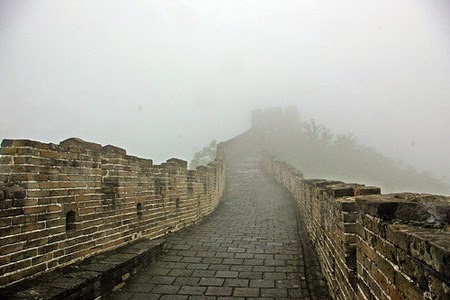
A few years ago, my partner and I were lucky enough to be able to take an incredible month-long trip to China. It took about six months of planning and preparation and before that, it had taken several years of “what if”ing to set it all in motion. We wanted to see the Yangtze River before it was entirely dammed. We wanted to see the Potala Palace and Tibet before it’s completely overrun with Chinese. We wanted to ride camels along what had been part of the Silk Road route. And we wanted to walk along the Great Wall. It was, in the truest sense of the phrase, a trip of a lifetime because we were able to do all the things we’d wanted to do and more. We experienced sights and sounds and emotions and awe – things so many people don’t have a chance to ever experience. 

One of the multitude of mysterious and marvelous impressions from that trip has stayed with me in a way that nothing else has—and it’s the powerful reminder that the journey is as important as the destination. Indeed, that the journey is sometimes even more important than the destination. It was cloudy and overcast when we reached the Great Wall. As we climbed higher and farther along the wall into the mountains, we found ourselves walking in the clouds themselves, unable to really see much beyond the grey-green rolling hills just surrounding the wall itself. At first, we were terribly disappointed, raging at the sky and wishing for the sun to break through so we could see the vistas and the land beyond. And as we raged, we started to fairly race to the next tower on the wall, to see if, just maybe, we’d get a better view. And it was then that I stopped us. Just stopped us so we could listen and look around and realize the magnificence of what we were actually doing, of where we were actually walking and standing, of the history, of the moment. We stopped in order to take mental and physical note of the journey itself. It seemed critical then to put aside the “when will we get there” in order to celebrate the “here we are.” And in doing so, we could rejoice in all that had transpired to bring us to that remarkable and special place—to capture the power of all that we’d done and all that the universe had allowed over many years to bring us to where we were right then. No less. No more. And just perfect.

So, we didn’t see the expansive views of mountains and unending wall we thought we’d see; that particular gift, for whatever reason, remained hidden. But the gifts we were given were, I think, far greater in depth and beauty – the gift of the knowledge that we had achieved something magnificent without even recognizing it; the gift of the knowledge that in experiencing exactly what we experienced, our lives were forever changed; the gift of being able to stop and know the now; and the gift of the next “what if” – what if we are able to come back to this place someday and on that day the sun might be shining?

And so it is with our lives and our storytelling. And so it can be with our health and our relationships. Sometimes it’s overwhelmingly vital for our souls and our selves to pay attention to the journey, to appreciate the efforts and the achievements, to allow the clouds to hide secrets not yet meant to be revealed. It seems to me if we’re too intent on only reaching our destination we lose a sense of magic and mystery. For it is by knowing where we are on our journey and letting ourselves be at ease with the unexpected that we will make our way to brilliant and rich destinations –and not necessarily the ones to which we thought we were always headed. How exciting it is to just think...what's beyond the great wall?

(c) emma d dryden, drydenbks llc

8.22.2010

The Valuing of Ourselves

What is something worth? The factors that determine the worth of something—a book, a cell phone, a vase, life insurance, a pair of shoes, a painting, therapy, a movie, a class, a piece of property—are many. We determine our answer based on how valuable we think the thing will be to us, how long-lasting the thing could be, how useful, how beautiful, how practical, how pleasing, how inspiring.

What is a person worth? The factors that determine the worth of someone to us are many and on the one hand, are not dissimilar to the sort of worth we put on an inanimate something—we determine our answer based on how valuable we think that person is to us, how long lasting a relationship with that person could be, how useful, how beautiful, how practical, how pleasing how inspiring that person is to us.

On the other hand, the answer to what a person is worth is often dictated by the tenets of the constructs of our society—corporate, religious, political, military, sexual, moral—and so we determine our answer based on how financially viable a person is to a bottom line, how stringently a person will further an agenda, how blindly a person will perform in the name of duty, how rigidly a person will follow a majority opinion, how hard a person will tow the line they’ve been handed, how unfailing a person will believe in what they’ve been led to believe, how stalwart a person will be when standing up for the company they keep or the company for which they work.

And so it is that we make our way through our lives and our work attempting to be a person of balanced worth in order to be a true friend, a valuable employee, an honorable member of every group to which we belong. As we journey the various paths to worthiness, however, I fear we’re more willing than we should be to believe that the opinions of others provide us with the correct and certain answers to a critical question we don’t ask often enough—What am I worth?

I can only believe that for the most part all of us want to be fair, are willing to meet our obligations, understand our responsibilities, take our friendships, families, jobs and memberships seriously and will do whatever it is we need to do to maintain and retain them without losing track of our own values, principles, and ideas. But what happens when someone—a parent, a boss, an elected official, an officer, a buyer, a teacher, a religious leader —what happens when someone who, by virtue of the way in which our society is set up, has been put in a position to determine an outcome that effects us individually tells us we’re not worthy? And what happens if strangers feel emboldened by one person’s assessment to start agreeing that we’re not worthwhile? What if something we write is censored, what if the way we pray is ridiculed, what if the way we love is violated, what if the vote we cast is obstructed, what if the way we look is denied?

How many of us are confident enough to take ownership of our own worth and express how valuable we think we are by expressing our beliefs, our desires, our intentions, our feelings even if it means being accused of dissent, opposition, defiance, immorality, sin? Some might call such an expression of self-worth selfish or self-serving. Some might call it dangerous. I submit that such an expression of self-worth is necessary and essential to the continuity of ideas, creativity, and exploration that makes us human. The valuing of ourselves is the valuing of our very existence. And surely that is most worth our while.

(c) emma d dryden, drydenbks llc